> ## Documentation Index
> Fetch the complete documentation index at: https://docs.refactron.dev/llms.txt
> Use this file to discover all available pages before exploring further.
# Overview
> Refactron finds legacy patterns in your Python and TypeScript code, refactors them deterministically, and proves nothing broke before writing a single byte.
## What is Refactron?
Refactron is a CLI for **safety-first refactoring** of Python and TypeScript codebases. The refactoring engine is 100% deterministic AST transforms — no LLM touches your code. Before any file is written, three gates must pass: syntax validity, import integrity, and your project's full test suite on a shadow tree. Atomic write or rollback — never partial state.
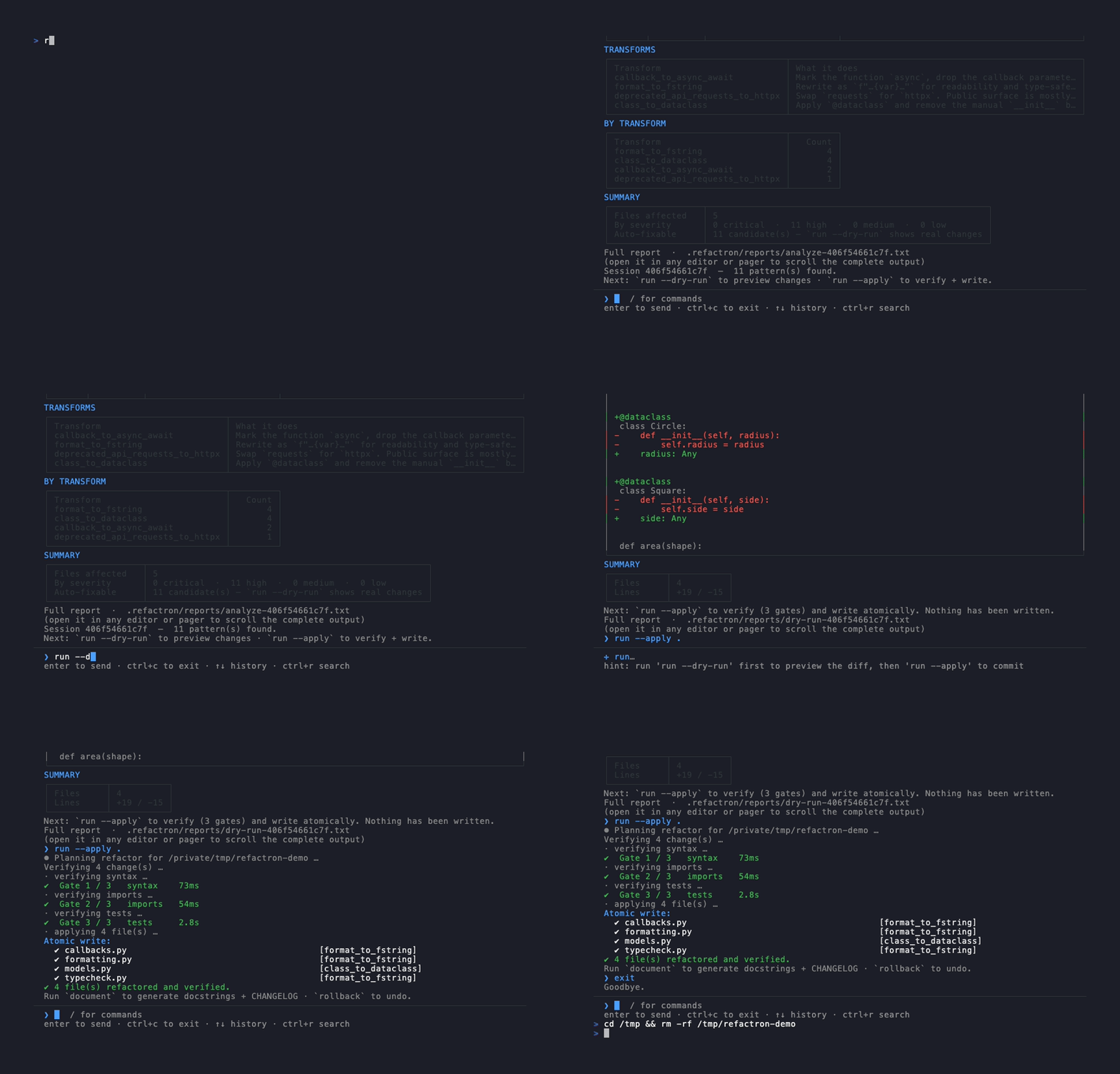 ```bash theme={null}
npm install -g refactron@0.2.3
cd your-project && refactron login
refactron analyze .
refactron run --apply
```
***
## Why Refactron exists
Every existing "AI refactoring" tool generates code and hopes you'll catch the bugs. NYU's study of 1,692 Copilot programs found \~40% had exploitable vulnerabilities. An ACM AST 2024 study found 92.45% of Copilot-generated tests fail or are broken when there's no existing suite. That's a non-starter for production codebases.
Refactron does the opposite. The engine is deterministic; the LLM is confined to Step 4 — generating documentation for already-verified refactors.
***
## Core differentiators
10 transforms (5 Python, 5 TypeScript) implemented as pure AST rewrites via LibCST and ts-morph. No statistical inference; no model temperature.
Syntax → imports → tests on a shadow tree. Every gate must pass before any byte hits your filesystem.
All-or-nothing rename via write-file-atomic. Either every change in a refactor commits, or none does.
Transforms refuse to apply when callers, mocks, or other-file dependencies would break. Skipped, not silently broken.
Documentation generation (Step 4) runs only on already-verified diffs. Five providers: Ollama, Groq, OpenAI, Anthropic, or our managed backend.
No Ruby/Go/Rust adapters yet. Self-analysis fails by design. We tell you what doesn't work in [the FAQ](/faq).
***
## How a refactor flows
```mermaid theme={null}
%%{init: {'flowchart': {'nodeSpacing': 65, 'rankSpacing': 90, 'padding': 16}, 'themeVariables': {'fontSize': '20px'}}}%%
flowchart LR
A([analyze]) --> B([run --dry-run])
B --> C([run --apply])
C --> V{"3 gates:
```bash theme={null}
npm install -g refactron@0.2.3
cd your-project && refactron login
refactron analyze .
refactron run --apply
```
***
## Why Refactron exists
Every existing "AI refactoring" tool generates code and hopes you'll catch the bugs. NYU's study of 1,692 Copilot programs found \~40% had exploitable vulnerabilities. An ACM AST 2024 study found 92.45% of Copilot-generated tests fail or are broken when there's no existing suite. That's a non-starter for production codebases.
Refactron does the opposite. The engine is deterministic; the LLM is confined to Step 4 — generating documentation for already-verified refactors.
***
## Core differentiators
10 transforms (5 Python, 5 TypeScript) implemented as pure AST rewrites via LibCST and ts-morph. No statistical inference; no model temperature.
Syntax → imports → tests on a shadow tree. Every gate must pass before any byte hits your filesystem.
All-or-nothing rename via write-file-atomic. Either every change in a refactor commits, or none does.
Transforms refuse to apply when callers, mocks, or other-file dependencies would break. Skipped, not silently broken.
Documentation generation (Step 4) runs only on already-verified diffs. Five providers: Ollama, Groq, OpenAI, Anthropic, or our managed backend.
No Ruby/Go/Rust adapters yet. Self-analysis fails by design. We tell you what doesn't work in [the FAQ](/faq).
***
## How a refactor flows
```mermaid theme={null}
%%{init: {'flowchart': {'nodeSpacing': 65, 'rankSpacing': 90, 'padding': 16}, 'themeVariables': {'fontSize': '20px'}}}%%
flowchart LR
A([analyze]) --> B([run --dry-run])
B --> C([run --apply])
C --> V{"3 gates:
syntax · imports · tests"}
V -->|pass| W["Atomic batch write"]
V -->|fail| R["Rejected —
tree untouched"]
W --> D([document --apply])
D --> E([done])
W -.->|drift-safe undo| RB([rollback])
```
Full breakdown of the safety model: [The 3-Gate Safety Model](/concepts/safety-model).
***
## Next steps
Install Refactron and run your first verified refactor.
How syntax, imports, and tests gate every write.
All ten transforms, with before/after and preconditions.
Every command, flag, and exit code.